 NLP Newsletter (Elvis)
1. Self-Improving Agents Survey
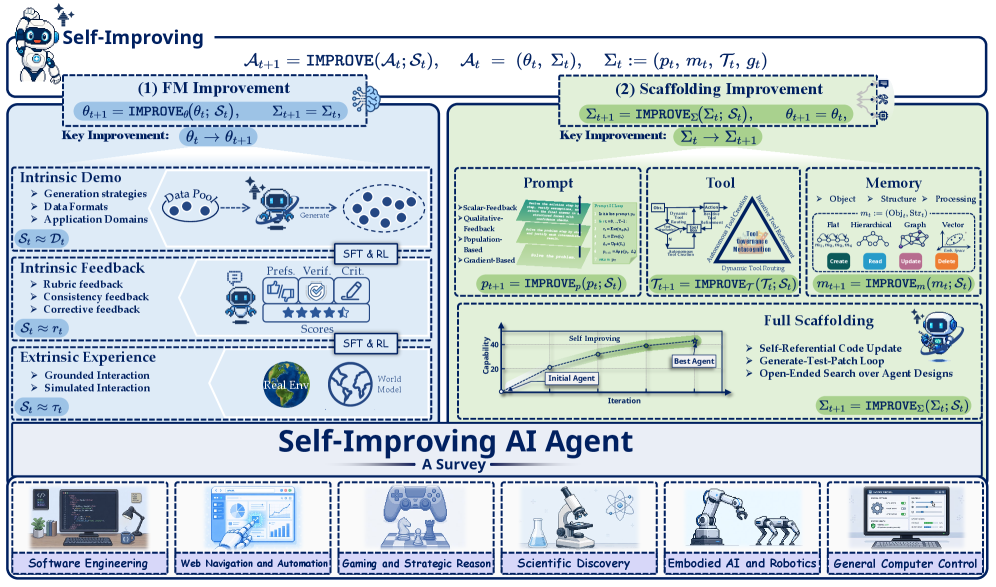
Self-improving agents are moving from research demos into deployed systems, and this survey gives the trend a clean formalism. It frames a modern agent as a foundation model coupled with an operational scaffold of prompts, memory, tools, and control logic, then treats self-improvement as a self-induced update that commits changes to either the weights or the scaffold.
Two update targets: Improvement splits into foundation-model updates to the weights and scaffolding updates to prompts, tools, memory, and control code, giving a shared vocabulary for work that usually looks unrelated.
Signals that drive change: The survey organizes methods by where the learning signal comes from, spanning intrinsic generative demonstrations, intrinsic evaluative feedback, and extrinsic exploratory experience in real or simulated environments.
Full-scaffolding frontier: The most open-ended methods rewrite the agent itself through self-referential code updates, generate-test-patch loops, and open-ended search over agent designs, pushing toward controllable evolution with little human input.
Why it matters: As teams wire agents to improve from their own experience, a single map of update targets, signals, and applications across software, web, gaming, science, and robotics turns a scattered literature into something builders can actually navigate.
From DAIR Academy
Want a guided version of a real weekend project? Our new hands-on lab, Docs for Agents with OpenWiki, has you run OpenWiki, LangChain’s documentation agent, against a real codebase. You generate an agent-ready wiki, steer what it writes, and keep the docs in sync as the code changes, across seven labs with automated checkpoint grading.
2. Metacognition in LLMs
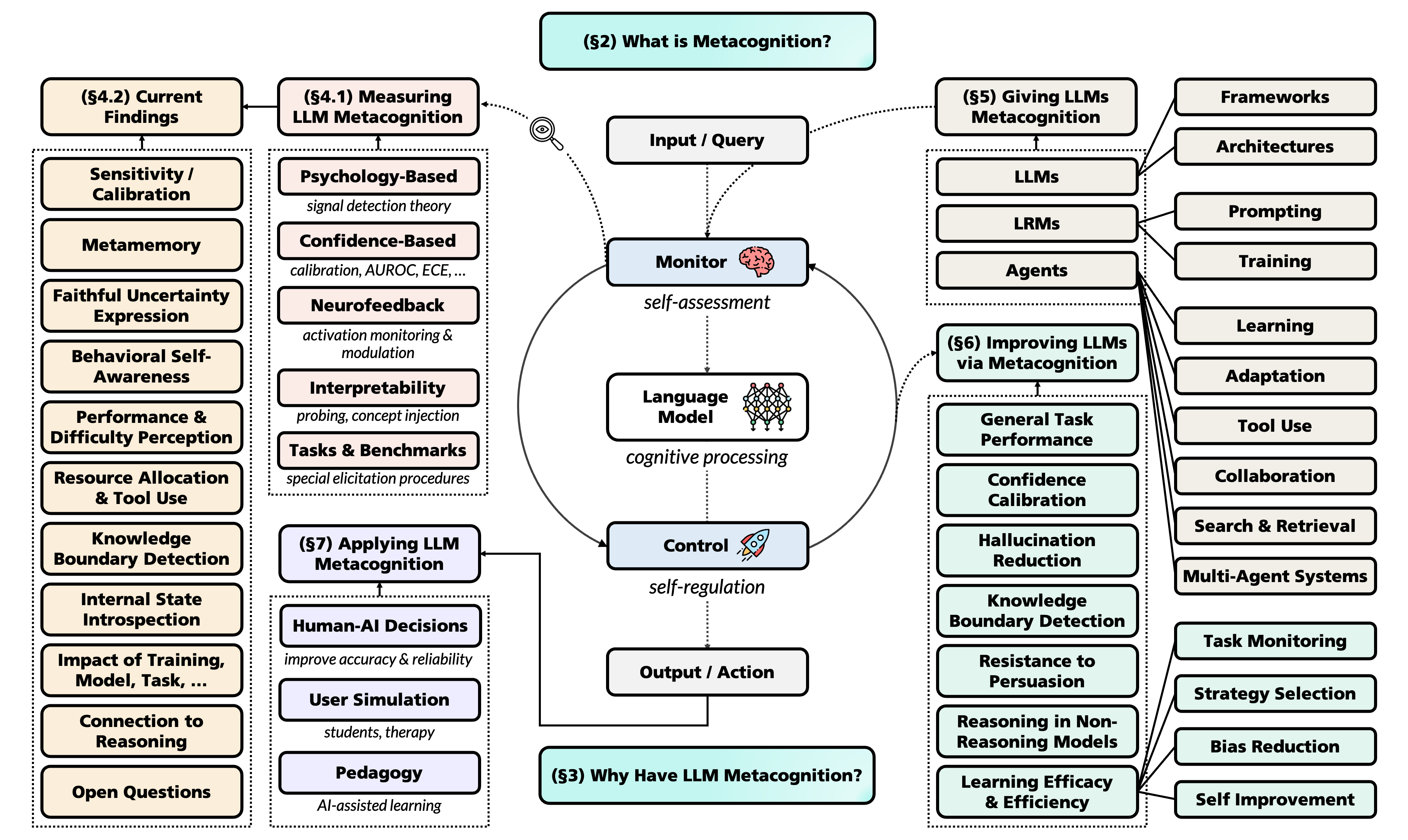
Confidence calibration, self-verification, knowing when to stop, and knowing what you do not know have mostly been studied in isolation. This survey from Yale and UC Irvine argues they are facets of one capability, metacognition, and organizes the field around a monitor and control loop wrapped around the language model.
Monitor and control framing: The model self-assesses before and after acting, then self-regulates by deciding whether to answer, retry, or defer, turning scattered behaviors into a single monitor-then-control cycle.
How it is measured: The survey catalogs psychology-based methods from signal detection theory, confidence-based metrics like calibration, AUROC, and ECE, activation-level neurofeedback, and interpretability probes such as concept injection.
How it is instilled and used: It reviews frameworks, architectures, prompting, and training that give LLMs, reasoning models, and agents metacognition, then shows gains in hallucination reduction, knowledge-boundary detection, and resistance to persuasion.
Why it matters: Metacognition underpins reliability, so a unified account of how to elicit, measure, and improve it gives builders a coherent target rather than a pile of one-off confidence tricks.
3. When Is Routing Meaningful
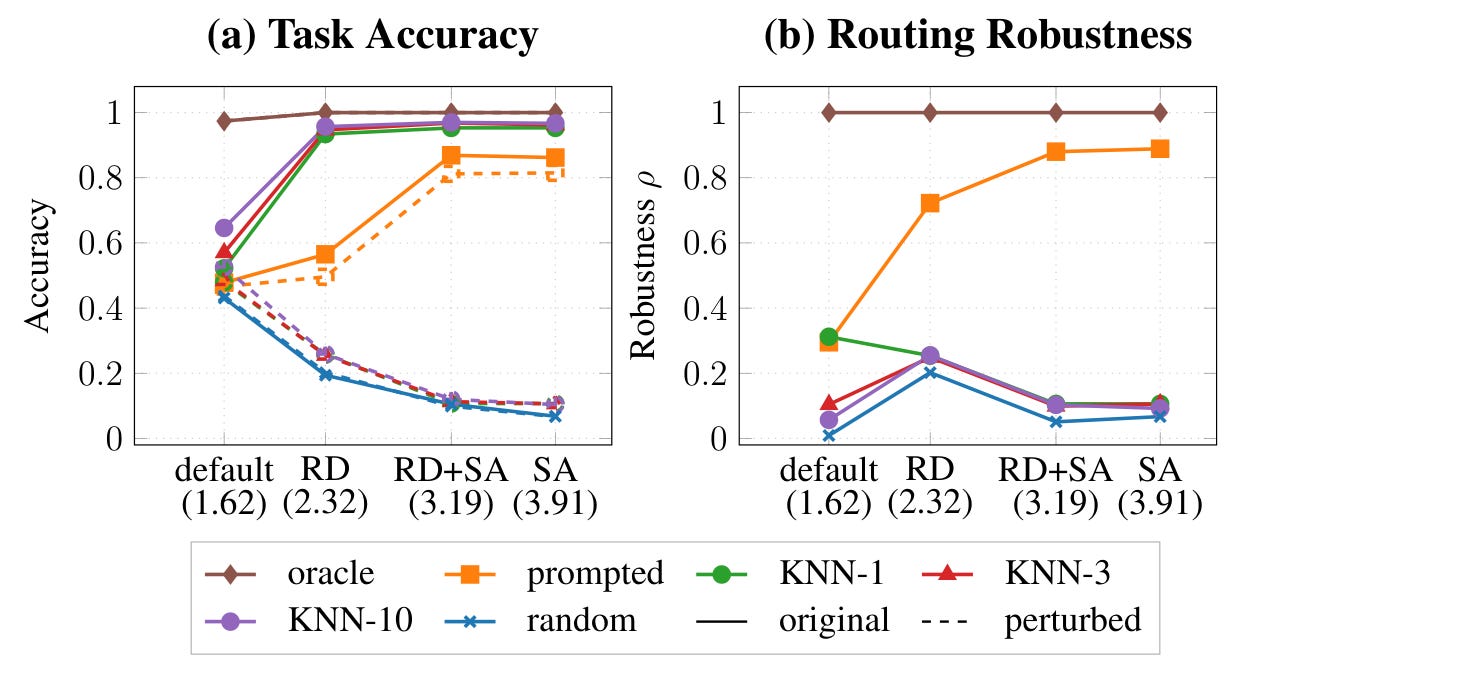
LLM routers and mixture-of-agents systems get judged on accuracy and cost, both of which can look great while the router is doing nothing. This DeepMind-affiliated work argues that whether routing means anything depends on two properties that are orthogonal to accuracy.
Two conditions for real routing: The society of models must be behaviorally differentiated, since routing is vacuous when every actor responds the same way, and assignments must stay stable when a query is rewritten.
A diversity measure that sees structure: The authors use Hierarchic Social Entropy to score how genuinely different a pool of models is, showing purpose-built specialist societies are far more diverse than large real-world model pools of similar size.
Accuracy hides fragility: Learned KNN routers gain accuracy on specialist societies yet collapse under paraphrase perturbations, while a prompted router keeps both accuracy and robustness, so clean-query accuracy alone can mask a meaningless router.
Why it matters: These two checks catch routers that look good and do nothing, and they show that a small, carefully curated society can recover most of the diversity of a much larger pool.
4. Harness Evolution Rethought
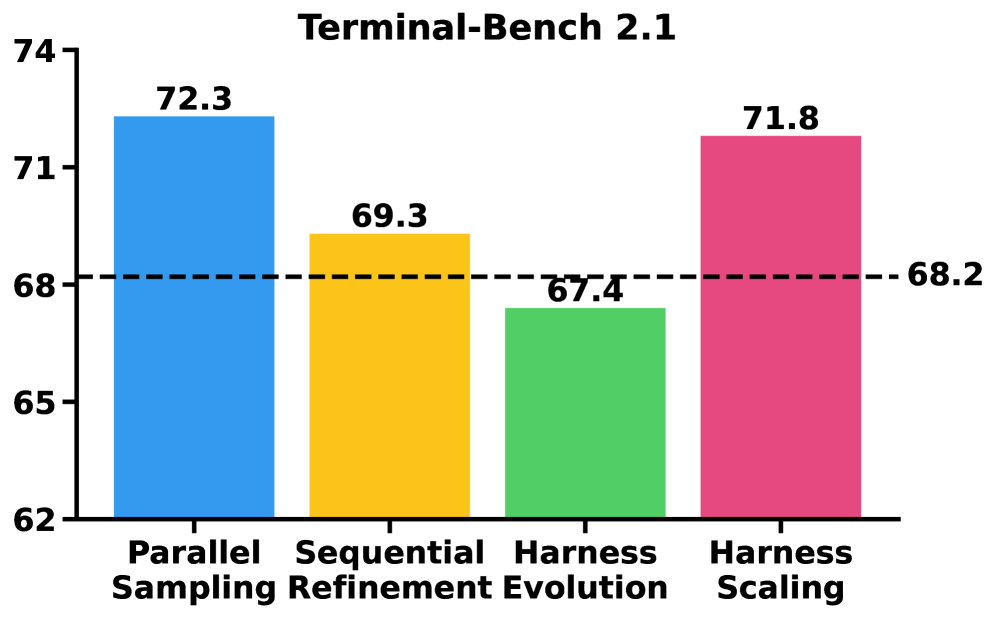
Automatic harness evolution is what many teams now use to squeeze more out of agents, but the reported gains might not be coming from the harness at all. This paper argues that harness evolution is itself a search procedure and must be compared against simple search baselines under matched budgets.
A fairer comparison: Because harness evolution repeatedly evaluates and revises candidates using task feedback, it should be benchmarked against task-level search under the same feedback and inference budgets, not against a single static harness.
The gains do not hold up: On Terminal-Bench 2.1 with GPT-5.4 and Claude Opus 4.6, evolved harnesses fall to 67.4, below the 68.2 baseline, while plain parallel sampling reaches 72.3 and harness scaling reaches 71.8.
Weak generalization: Beyond underperforming simple test-time scaling, the evolved harnesses transfer poorly, undercutting the assumption that a searched configuration captures something durable.
Why it matters: The result is a caution for anyone banking on self-evolving harnesses, and a call for evaluation protocols that separate genuine harness benefit from the effect of simply spending more compute on search.
5. Tracing Agentic Failure
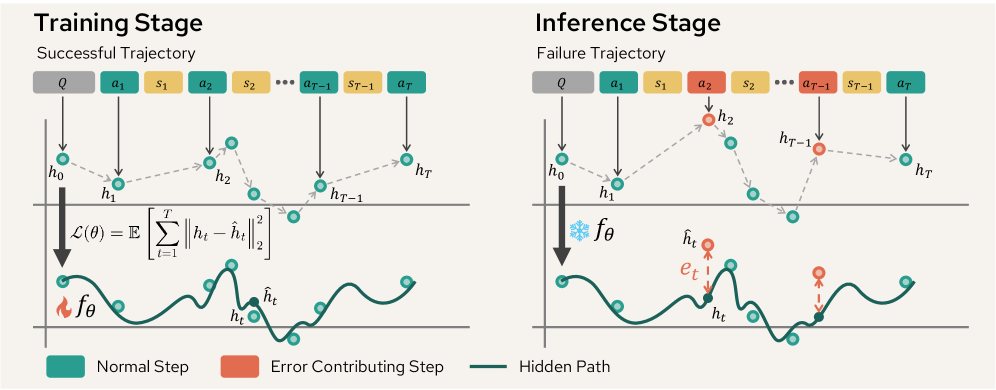
Finding which step in a failed agent run actually caused the failure usually means either labeling failure data or running expensive per-step prompting. This Microsoft and UW-Madison work skips both by learning what success looks like and flagging deviations from it.
Train on success, judge failure: OAT uses one-class learning with neural controlled differential equations to model the latent dynamics of successful trajectories, then scores each step of a failed run by how far it strays from that learned flow.
Cheap and label-free: With only 100 successful trajectories and no failure labels, it turns failure attribution into anomaly detection, avoiding the annotation and prompting costs that make current methods impractical at scale.
Strong, fast results: It delivers a 200 to 5000 times speedup over prompting-based attribution while improving F1 by 20% in-domain and 7% out-of-distribution.
Why it matters: Production agents fail in long, probabilistic, tool-mediated runs where the decisive misstep is hard to localize, and a cheap detector that only needs success data makes routine debugging feasible.
6. Failure as a Process
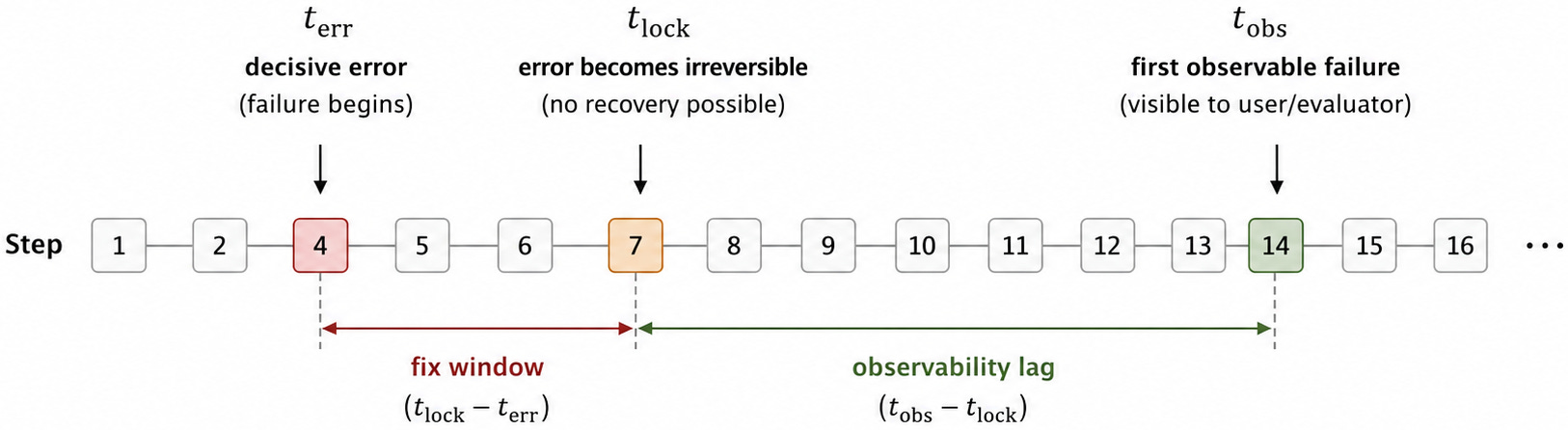
When a coding agent fails a task, the final pass or fail label hides when the run actually went wrong. This large-scale study treats failure as a timeline and annotates over 63,000 execution steps to see how coding-agent runs break down.
Failure has three timestamps: Each trajectory is marked with the decisive error, the point where the error becomes irreversible, and the first observable failure, exposing a fix window and an observability lag that pass or fail labels erase.
Built on real trajectories: The team collected 3,843 runs from seven frontier models across three scaffolds on Terminal-Bench, filtered to 1,794 valid trajectories, and annotated them with high inter-rater agreement.
Mostly epistemic, mostly early: About 57.9% of failures come from misusing available information rather than a capability gap, with false premises the single largest trigger at 30.7%, and errors typically start early and stay hidden until recovery is impossible.
Why it matters: Naming the onset, lock-in, and observation points gives teams a vocabulary to intervene before an agent run is unrecoverable, instead of only noticing at the end.
7. LingBot-World 2.0
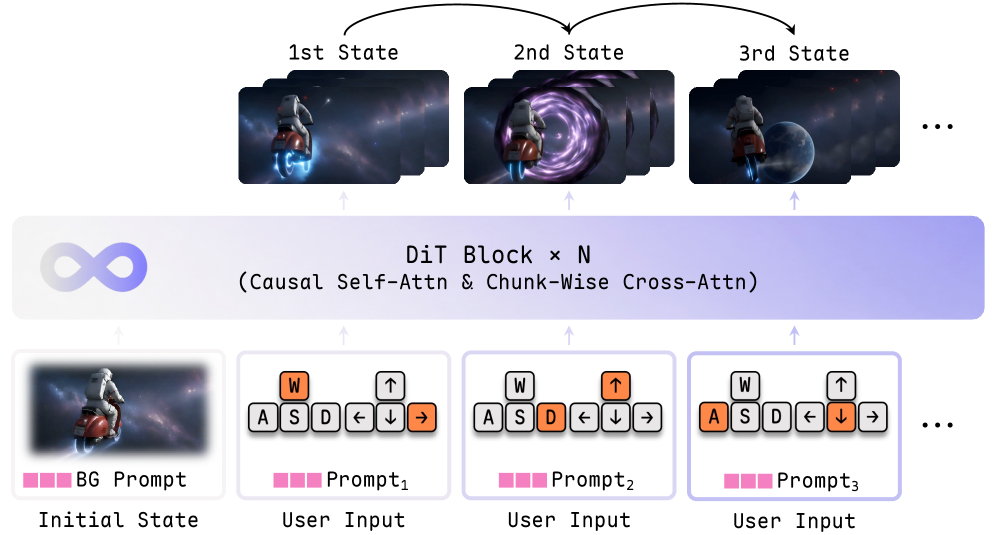
Most world models fall apart after a few seconds, smearing textures and warping geometry as errors compound frame to frame. LingBot-World 2.0 from Robbyant holds 720p at 60 fps for a full hour of interaction and ships fully open.
Causal backbone beats drift: A causal generation stack trained from the start to limit error accumulation replaces the usual bidirectional design, keeping scenes coherent well past the point where prior causal models collapse.
Durable teacher, real-time student: The high-capacity base model is distilled into a few-step student that renders in real time, so you get both long-horizon stability and responsive interaction from one system.
Act inside the world: Rather than only moving a camera, you can fight, draw a bow, cast spells, and type in events like weather changes, while an agentic harness of a scene-reading brain, a pilot, and a director keeps generating context-aware content.
Why it matters: Pairing hour-scale, real-time, high-fidelity generation with an open release, including a 14B model and a lighter single-GPU variant, gives researchers a serious interactive world model to build on rather than a closed demo.
8. Filtered Sabotage Monitoring
Chain-of-thought monitoring is treated as a reliable safety layer, but this study shows monitors often detect sabotage better with less access, not more. Giving a monitor the full agent reasoning trace can bury the signal, and the authors introduce extract-and-evaluate monitoring, where one monitor isolates the relevant excerpts and another scores them, lifting sabotage detection by 16.8 points on BigCodeBench-Sabotage with a GPT-4.1-mini monitor. Agents unaware they are watched are far easier to catch, and monitors reading long traces gain the most from filtering.
9. GFlowRL
Reward-maximizing RL tends to collapse large reasoning models onto a single dominant mode, and GFlowNet-style training is appealing because it matches reward distributions and keeps diverse reasoning paths. GFlowRL scales this to modern post-training by replacing the hard-to-learn partition function with an in-batch Monte Carlo estimate computed from the rollout group the pipeline already produces. It is the first GFlowNet-style RL algorithm to train stably across both dense and sparse architectures, reaching a 2048 Codeforces rating at 14B and outperforming prior methods on math, code, and adversarial red-teaming benchmarks like AdvBench and HarmBench.
10. LingBot-VLA 2.0
LingBot-VLA 2.0 is an open-source generalist embodied model from Robbyant, trained across 20 robot configurations from single-arm rigs to humanoids like Unitree G1 and Fourier GR-2. It packs 60,000 hours of curated data, 50,000 hours of real-robot trajectories plus 10,000 hours of egocentric human video, into one policy that also predicts future depth and semantic features before it acts. On 9 GM-100 tabletop tasks it beats π0.5 and GR00T N1.7 across two robot platforms and stays ahead on long-horizon mobile tasks, running at about 130 ms on a single RTX 4090D with open-sourced post-training code.