 Tyler Folkman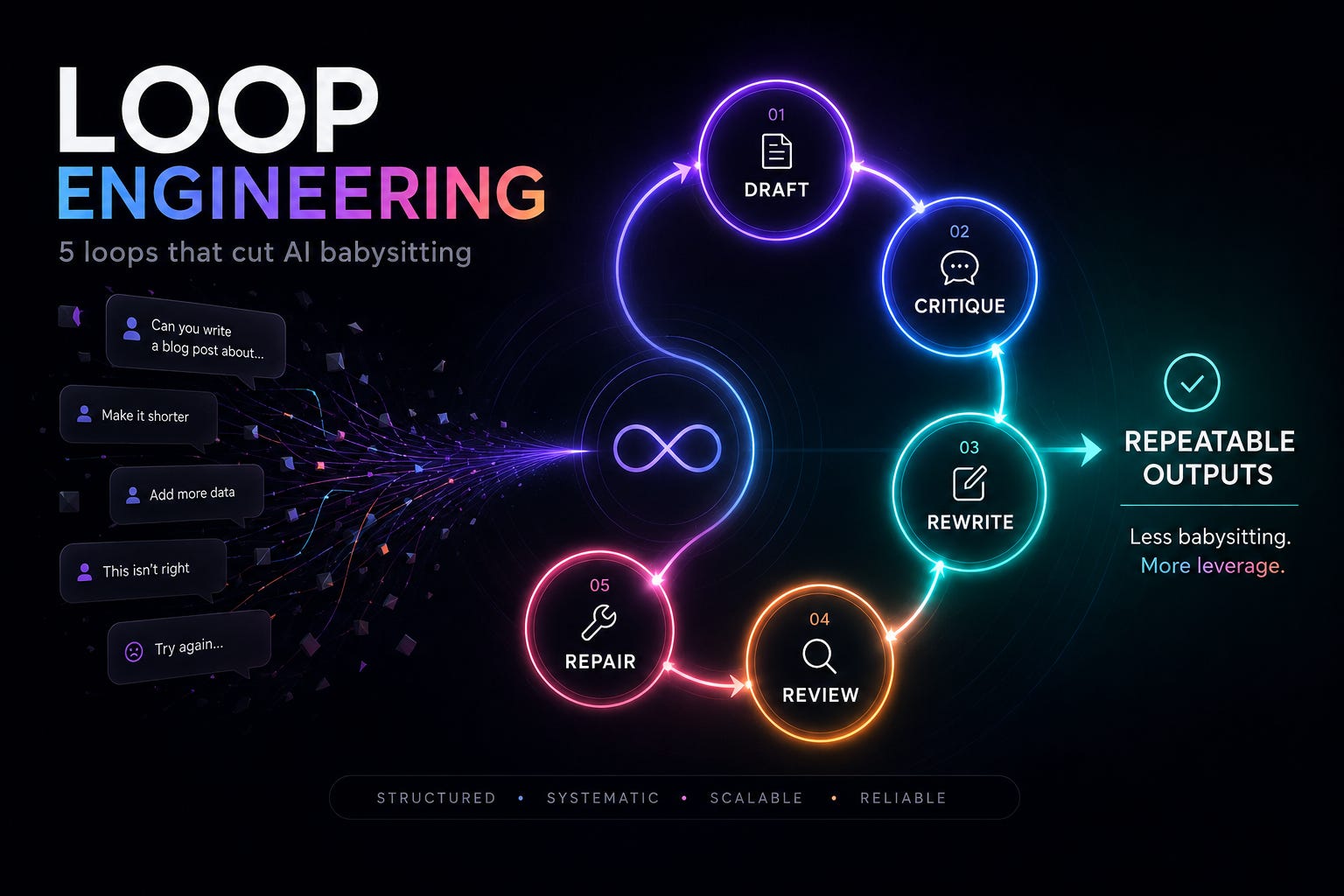
I used to think my AI problem was prompting.
Every failure looked like a prompt problem: weak context, missing examples, too vague, too clever.
So I kept rewriting prompts, then watched the same task need the same manual steering the next time.
The prompt got better. The work did not get repeatable. I could get one great answer from Claude, ChatGPT, or Gemini if I sat there long enough. I could nudge it, correct it, paste back missing context, and catch the hallucinated assumption.
But the next time I needed the same job done, I had to do the dance again.
That is not automation. That is artisanal prompting. At an illustrative $150/hour operator cost, 25 minutes of AI babysitting costs $62.50 before counting the model bill.
The shift that stuck for me was this: stop treating the model call as the system. Treat the model call as one step inside a loop.
The industry term starting to show up for this is Loop Engineering. That framing fits because my content and coding workflows kept breaking at the review step, not the prompt step.
Prompt engineering asks: “What should I say to the model?”
Loop engineering asks: “What should happen before, during, and after the model responds so the work gets better without me babysitting every turn?”
The prompt handles one call. The loop handles the draft, review, repair, and stop conditions around it.
The cost difference shows up fast. If a loop cuts the same task from 25 minutes of steering to 7 minutes of review, the illustrative savings are about $45 every run. Do that ten times in a month and the point is removing 3 hours of repeated steering, not shaving pennies from the API bill.
This is worth naming now because models can do multi-step work, but not reliably without boundaries. Forbes described loop engineering this month as instructing AI to iterate until a specified condition is met, with clear goals, assessment, human checkpoints, stoppage rules, and testing. MindStudio made the coding-agent version sharper: without a clear definition of “done,” agents either run forever or stop arbitrarily. (Sources: Forbes, MindStudio)
LangChain’s 2026 agent evaluation checklist points at the same shift: useful agent work has to move from “can we do this?” to “can we still do this?” through regression evals, quality gates, feedback, and versioned prompts/tools. That is loop design. (Source: LangChain, Agent Evaluation Readiness Checklist)
Here is the simplest version that changed my work.
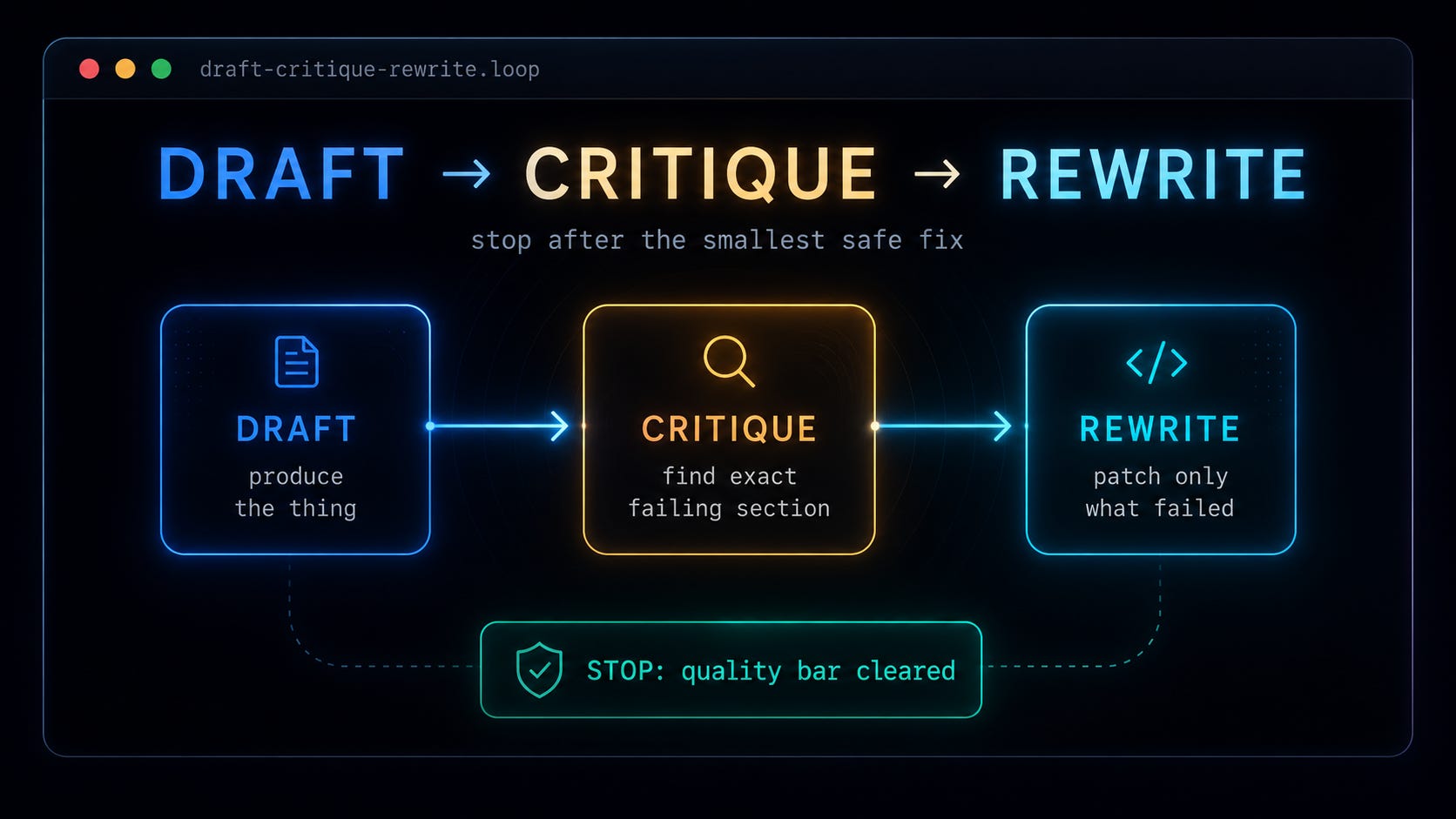
The first loop that stuck: Draft → Critique → Rewrite
I stopped asking for “a better draft.”
Instead, I split the job into three roles:
1. Draft the thing.
2. Critique it against explicit standards.
3. Rewrite only the failing sections.
The important part is step three. If you let the model rewrite the whole piece every time, it often fixes one issue and introduces three new ones. Voice drifts. Structure gets flatter. Specific examples get sanded into generic advice.
So the loop needs a constraint:
Rewrite the smallest failing section only. Preserve everything that already works.
That one sentence saved me more time than most “advanced prompt frameworks.”
My content workflow now uses this pattern constantly. Draft first. Review for AI-isms, genericness, missing lived evidence, weak stakes, and platform shape. Then patch the smallest failing section. Not the whole draft.
Same pattern works in code: implement, test, review, patch the smallest safe fix, re-run. In research: collect sources, extract claims, critique unsupported claims, rewrite only what needs stronger evidence.
A better prompt can improve one output. A better loop improves every future run of that work.
Below is the operator version: the five loops I reuse when prompting starts costing attention instead of saving it, with templates, stop rules, failure modes, and when each loop is worth running.
If you are still manually steering the same draft, code review, research pass, or agent workflow twice, this is the system I would install first.