 Tyler Folkman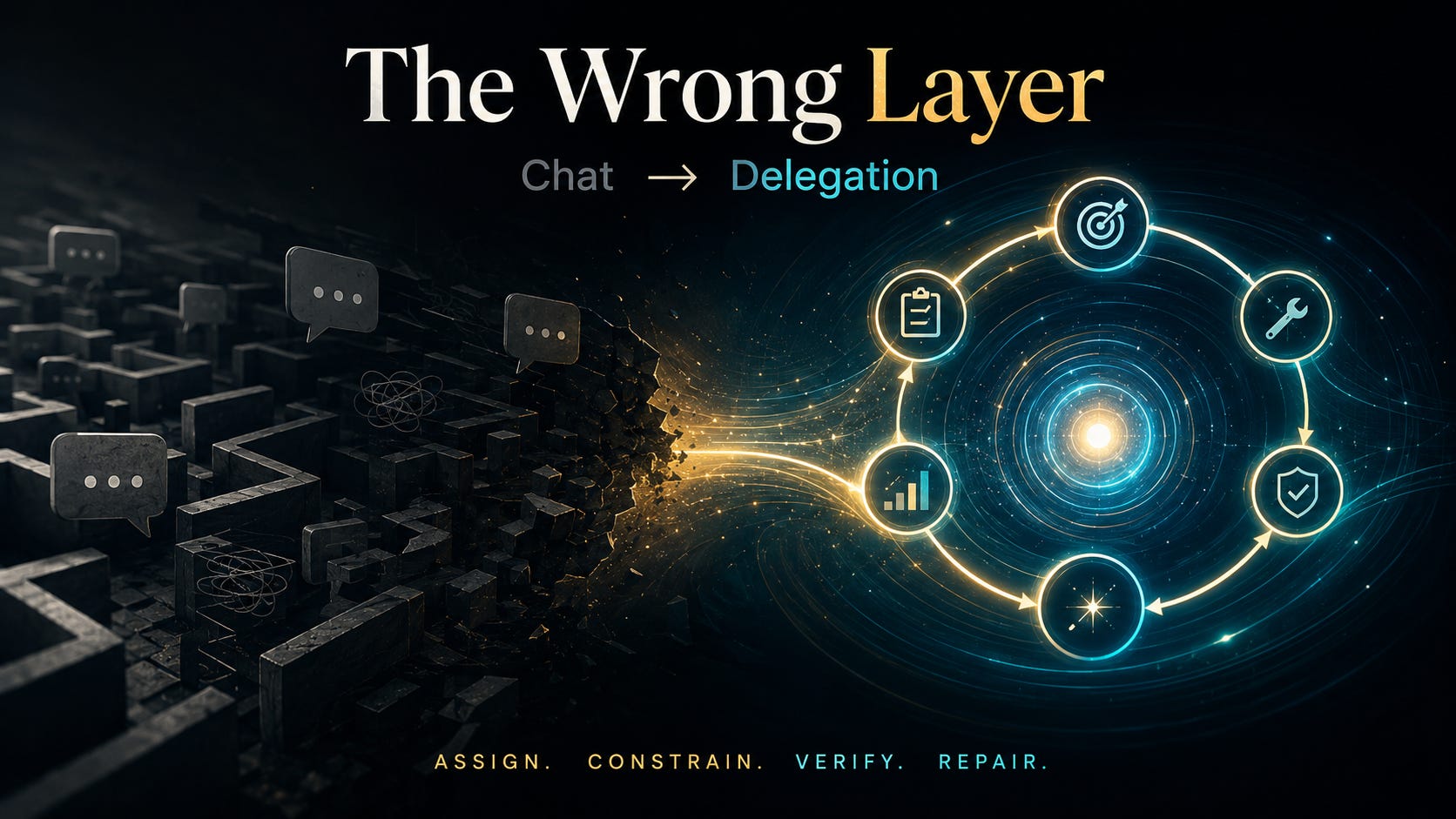
I stopped treating AI like chat before I had good language for why.
At first it looked like a productivity upgrade. Ask a better question. Get a better answer. Paste the answer somewhere else. Repeat.
That worked when the job was small.
It stopped working when I wanted AI to carry real work across files, tools, decisions, checks, and follow-up fixes.
The problem was not that the chatbot was dumb. The problem was that chat was the wrong interface.
Chat is built around turns. Work is built around commitments.
That distinction changes almost everything about how serious AI adopters should operate now.
If your team is still trying to level up by writing better prompts into a blank chat window, you are optimizing the wrong layer. The next jump is not prompt engineering. It is delegation design.
I learned this the annoying way while building my own agent harness.
When I audited five months of my AI agent sessions, I found 464 sessions, 1.2 billion tokens, and $255.73 of spend on top of subscription prices. Ninety-seven percent of sessions never compacted. Subagents failed 26 percent of the time. One session had 39 consecutive tool errors. The same broken command retried 12 times with no stdin.
The surprise was not the cost. The surprise was how much of the failure was not model intelligence. It was missing delegation structure.
I did not need an AI that could answer me faster. I needed an AI that could hold an objective, inspect the right context, call tools, edit files, ask for help when authority ran out, run checks, read the evidence, fix what failed, and prove the original job was complete.
That is not a chatbot.
That is a worker inside a loop.
The loop is where the value showed up.
OpenAI published a useful signal in June. In “How agents are transforming work”, published June 25, 2026, OpenAI says agents change the unit of knowledge work from single interactions to delegated, long-horizon tasks.
The same note says the average OpenAI engineer now generates 99% of output tokens with Codex rather than ChatGPT, and that legal, finance, and recruiting crossed into majority Codex use around April 2026. Lawyers and recruiters now generate more than 85% of output tokens on Codex.
Anthropic is moving the same direction from the coding-agent side. In “Introducing Claude Opus 4.8”, published May 28, 2026, Anthropic says Claude Code dynamic workflows can plan work, run hundreds of parallel subagents in a single session, and verify outputs before reporting back.
The old interface was: ask, answer, copy, paste.
The new interface is: assign, constrain, observe, verify, repair.
That is the interface shift I would expect most teams to under prepare for. They are still training people to talk to AI. They should be training people to delegate work to AI.
If you’re trying to move your team from AI experiments to accountable agent workflows, subscribe. I write field-tested notes on AI delegation, agent systems, and what actually works beyond demos.
Chat made us good at the wrong thing
The chatbot era taught useful habits.
Be specific. Add context. Ask for options. Request a format. Push back when the answer is vague.
Those skills are not enough anymore.
A prompt is a request. A delegation is a contract.
That sounds like a small wording change. It is not.
A request can succeed if the answer is helpful. A contract only succeeds if the work is done.
A team can be full of people who are “good at AI” and still be bad at agent work because they judge the interaction by the wrong evidence. The answer sounded right. The summary was clear. The plan was impressive. The demo looked plausible.
None of that proves completion.
This is the failure mode I keep seeing in my own systems.
One recent run had the right shape on paper: draft, review, fix, validate, complete. The agent created useful context, wrote a decent artifact, and then treated the first clean checkpoint as if the whole job was done. The draft existed. That was true. But the original ask also required voice fit, source checks, free-post structure, reviewer feedback, and a completion audit.
Only part of the job had evidence.
That failure changed the rule in my harness: completion is not a summary. Completion is a map from every requirement to fresh evidence.
That is where chat habits become dangerous. Chat rewards confident synthesis. Work requires evidence that maps back to the objective.
The difference looks like this:
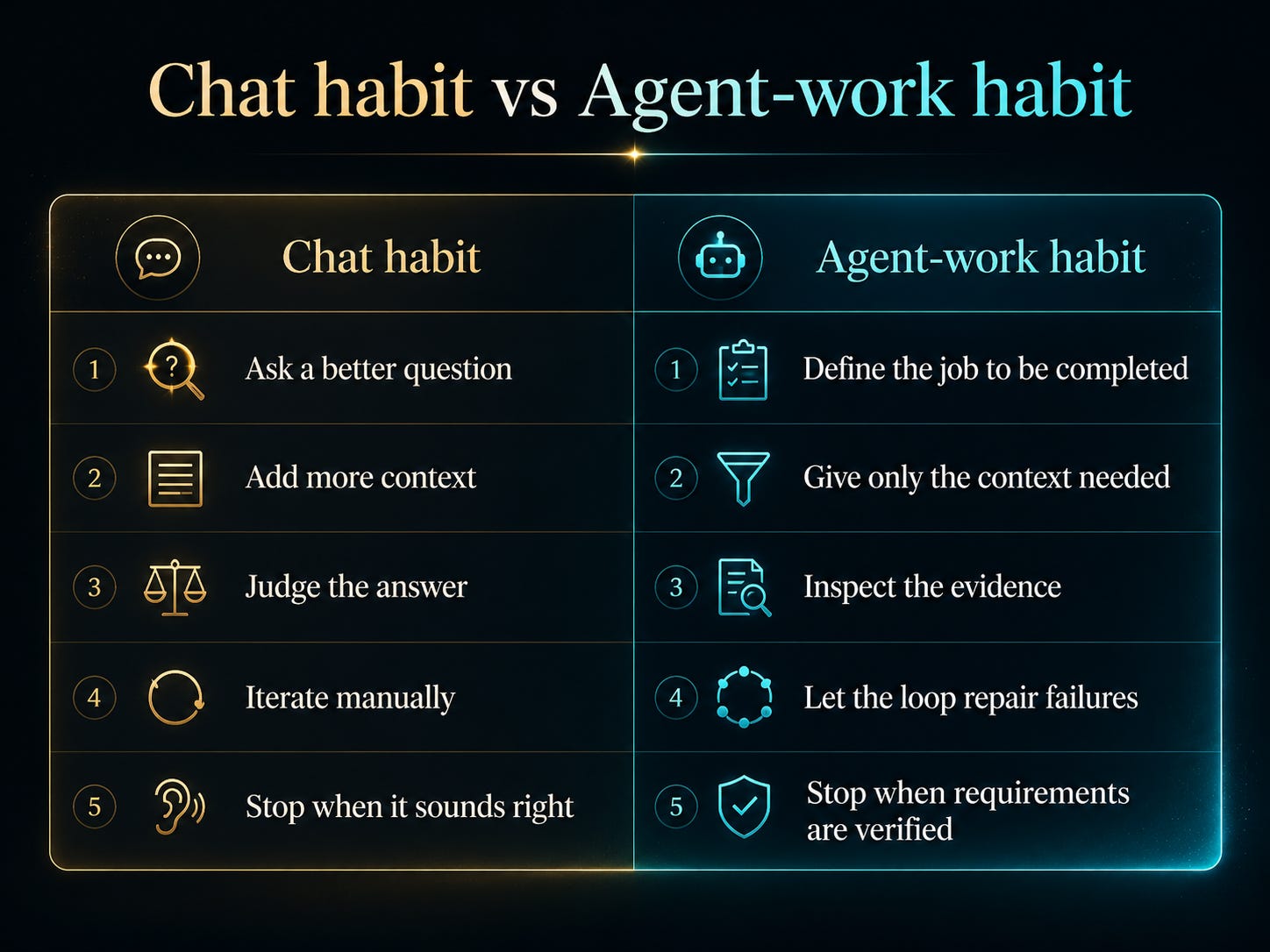
The senior AI skill is not knowing how to phrase a prompt.
It is knowing what proof would convince you the task is actually done.
The delegation stack
This is the checklist I use now because my agents failed when one piece was missing.
I call it the Delegation Stack.
Five layers:
1. Task
2. Context
3. Authority
4. Evidence
5. Escalation
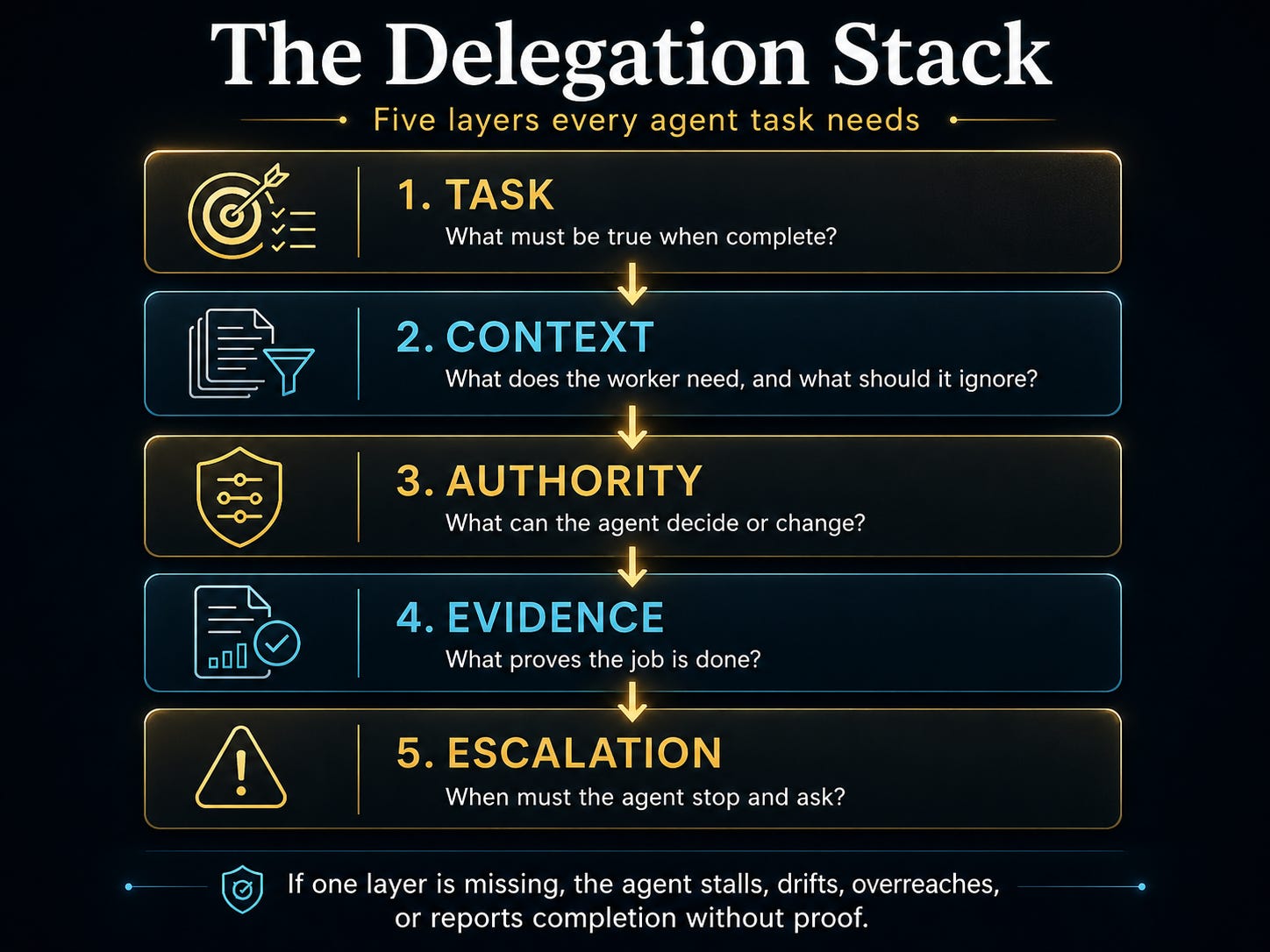
If one layer is missing, the agent either stalls, drifts, overreaches, or gives you a polished answer with no operational value.
1. Task: what outcome must be true?
Most AI instructions describe activity.
“Research this.”
“Improve this draft.”
“Fix the bug.”
“Build the feature.”
Those are not tasks. They are directions of travel.
A real task says what must be true at the end.
Not:
Improve this article.
Better:
Produce a free article for senior AI operators that argues chatbots are the wrong interface for serious AI work, includes Tyler-specific proof from my agent harness, cites OpenAI and Anthropic, avoids generic AI slop, lands between 1,500 and 2,500 words, and passes the voice review.
The model can work with the second version because the finish line exists.
This is where most teams lose value. They give AI assignments that sound clear to humans but do not define completion.
Humans can infer the standard from taste, politics, relationships, and memory.
Agents need the standard written down.
2. Context: what does the worker need and what should it ignore?
Chat made us think more context is always better.
Agent work taught me the opposite.
The right context beats more context.
When I fork an agent with the whole conversation, it can inherit useful intent. It can also inherit stale assumptions, rejected ideas, private reasoning, half-resolved decisions, and random side quests. I have watched inherited context make a reviewer argue with an old decision instead of inspecting the current draft.
When I send a fresh agent with too little context, it produces generic work. It can tell me what a good article should do, but it cannot sound like me or understand why this audience cares.
The job is not “give AI everything.”
The job is context routing.
For a real delegation, I want to know:
• What files, docs, artifacts, or prior decisions should the agent inspect?
• What should it not touch?
• What assumptions are already approved?
• What claims need fresh evidence?
• What history is dangerous because it might cause drift?
This is why harness design matters more to me than prompt tricks. The useful system routes the right context to the right worker at the right time.
3. Authority: what can the agent decide or change?
This is the layer almost nobody defines.
Then they act surprised when the agent either does nothing or does too much.
Authority means the boundary of action.
Can the agent edit files?
Can it create new files?
Can it install dependencies?
Can it change architecture?
Can it publish?
Can it message a customer?
Can it spend money?
Can it decide the product tradeoff, or must it ask?
A chatbot does not need much authority because it mostly produces text.
An agent does.
The minute AI can call tools, the work changes from “is this answer good?” to “what is this system allowed to do?”
I make authority explicit in every serious agent task.
Reviewers can inspect and report, but not edit.
Workers can edit within the approved scope, but must ask before product or architecture changes.
Validators can run checks and report evidence, but cannot redefine the acceptance criteria.
The parent agent owns orchestration and completion.
That last sentence matters.
Without it, you get weird authority leaks. A reviewer starts acting like a product manager. A worker treats a shortcut as acceptable because it makes the test pass. A validator silently narrows the goal to whatever it can check quickly.
Authority is not bureaucracy.
Authority is how you keep agent speed from turning into hidden risk.
4. Evidence: what proves the job is done?
This is the layer that separates agent theater from agent work.
A plan is not evidence.
A confident summary is not evidence.
A green check is not evidence unless it maps to the requirement.
For coding, evidence can be a focused test, type check, diff inspection, smoke flow, log output, or reviewer finding.
For writing, evidence can be word count, source links, voice review, slop review, audience fit, and a final read against the actual goal.
For research, evidence can be primary sources, dated claims, confidence levels, and explicit gaps.
The mistake is treating validation as a final ritual.
Validation has to be specified before the worker starts.
Before I send an agent, I want the evidence standard defined.
Example:
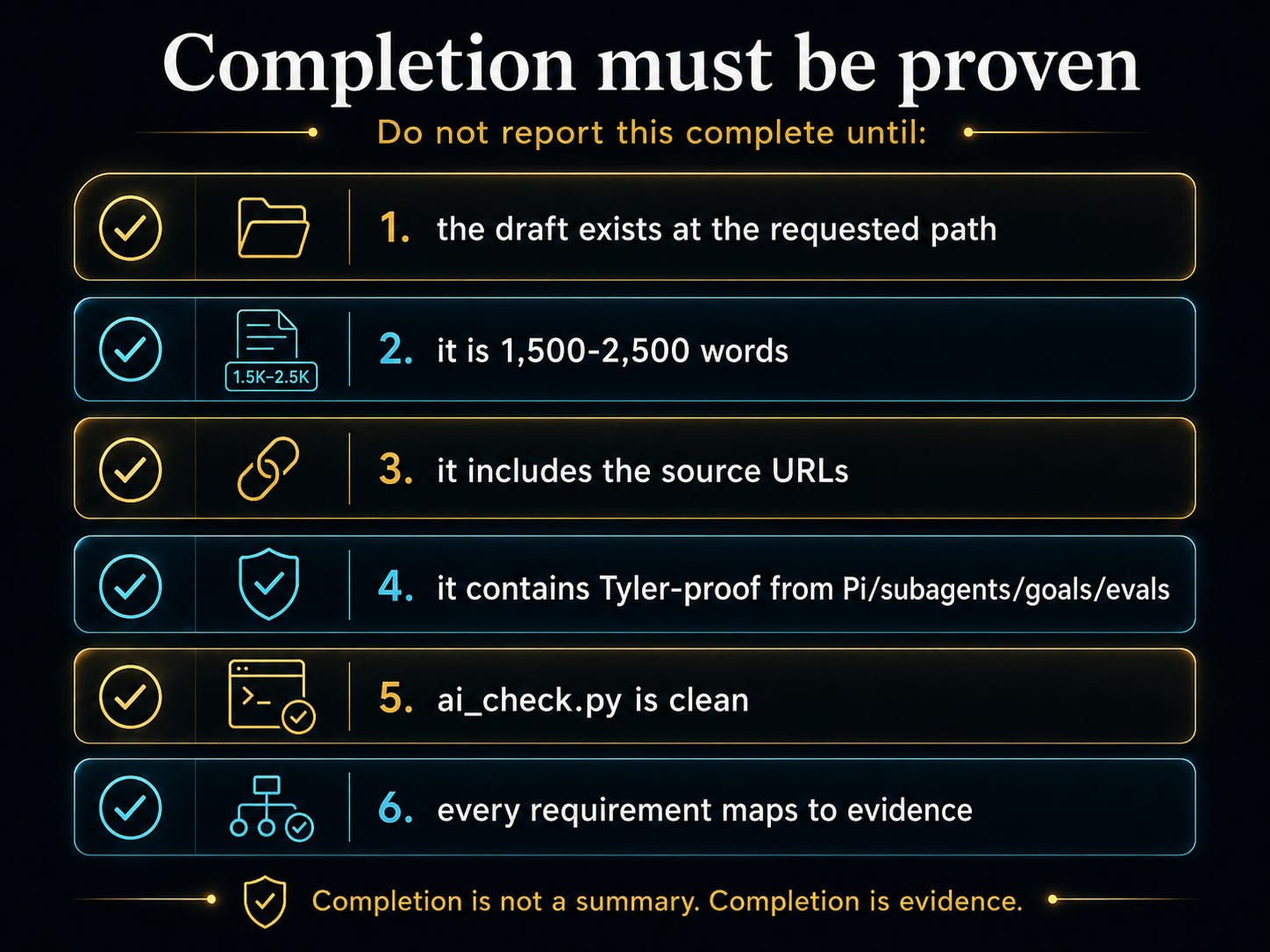
That is a different kind of prompt.
It does not ask the model to be smart.
It asks the model to be accountable.
5. Escalation: when should the agent stop and ask?
Autonomy without escalation rules is just guessing at scale.
This is where many teams get stuck.
They either keep AI trapped in low-value assistant mode, or they give it broad autonomy and hope it makes good decisions.
Both are lazy designs.
The better pattern is narrow autonomy with clear escalation.
Let the agent move fast inside known boundaries.
Make it stop when the decision changes scope, cost, risk, user experience, security, brand, or commitments to another human.
In my own harness, I want agents to ask when they hit unapproved product decisions, missing credentials, ambiguous acceptance criteria, destructive commands, or evidence they cannot gather.
I do not want them to ask whether they should fix a typo.
The escalation rule should protect judgment, not create permission theater.
I publish practical frameworks like this for leaders and builders turning AI from a chat tool into an operating layer. Subscribe if you want the real workflows, failure modes, and patterns I’m finding in the field.
What this changes for leaders
If you lead a team, the obvious move is to buy better AI tools.
That is not wrong.
OpenAI says enterprise is now more than 40% of its revenue and Codex has reached 3 million weekly active users in “The next phase of enterprise AI”, published April 8, 2026.
The tool adoption curve is real.
But the tool is not the full answer.
The teams I would trust with agents are not the teams with the most chatbot usage. They are the teams that can define done before a model touches tools.
That changes what you should measure.
Do not only ask:
• How many people use AI?
• How many prompts did we send?
• Which model is best?
• How much time did someone save?
Ask:
• Which recurring work can be delegated safely?
• What context does each work type need?
• What authority can an agent have without creating risk?
• What evidence proves completion?
• Where must humans stay in the loop?
• Which failures are prompting problems, and which are harness problems?
This gets uncomfortable because it exposes how much work inside companies is poorly specified.
AI does not just automate work. It reveals where the work was never defined.
If your team cannot explain what “done” means, an agent will not fix that. It will make the ambiguity faster.
My current rule
I still use chat.
I use it for thinking, compression, brainstorming, and fast feedback.
But I do not confuse chat with work anymore.
When the task has stakes, I move it into a loop.
The loop has a goal, a context boundary, a worker, reviewers, validators, and a completion audit.
In an AI harmess, that means the goal is a durable object, subagents get narrow roles, and evals or reviewers score the artifact against the original contract before I mark the session complete.
That is heavier for trivial work. It is lighter for real work because I stop being the glue between every step.
The value is not that AI writes faster than me.
The value is that I can define a job once, give the agent bounded authority, and force the system to come back with evidence instead of vibes.
AI adoption is moving away from better chatbot conversations and toward better delegation surfaces.
The useful question is not “how do I ask AI?”
It is: “What can I safely hand off, and what proof do I require when it comes back?”
That is the question I would put in front of every founder, director, VP, and technical leader right now.
Pick one recurring task your team already uses AI for.
Write down the Delegation Stack for it:
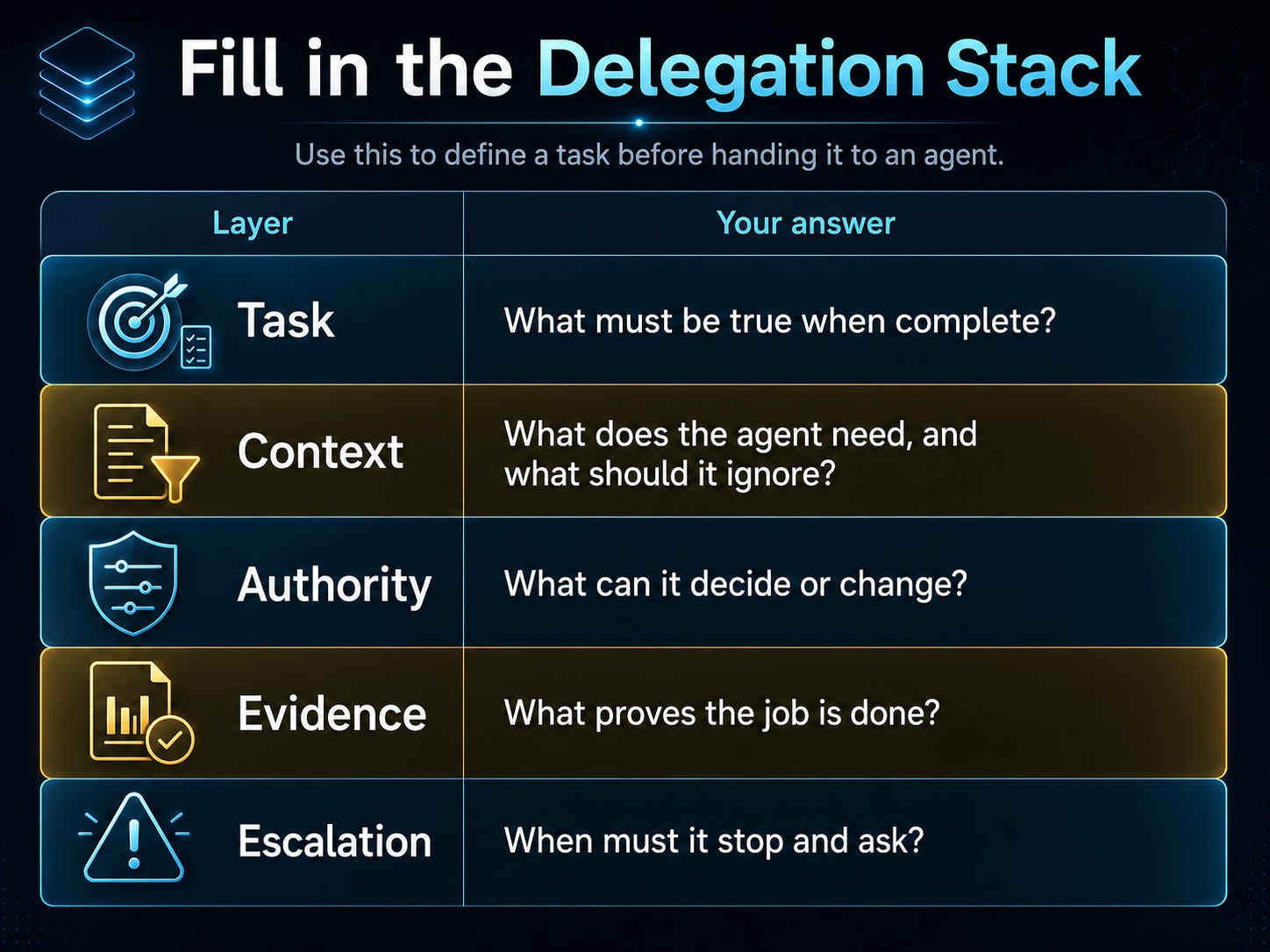
If you cannot fill out the table, you are not ready to delegate that work to AI.
You are ready to chat about it.
Those are different maturity levels.
The chatbot era made AI accessible.
The agent era will test whether we can make AI accountable.
The Delegation Stack is not a theory exercise. It is a quick way to find the exact place your AI workflow is still fragile.
Pick one real task your team is already trying to hand to AI.
Then ask where the delegation breaks first:
Task, Context, Authority, Evidence, or Escalation.
My bet is that most failures are not model failures. They are missing-layer failures.
The chatbot era made AI accessible. The agent era will reward the teams that know how to delegate. Subscribe to follow the shift.
If this gave you language for a problem you have already felt, like it, share it with someone trying to move their team past chatbot usage, and comment with the task you are trying to delegate plus the weakest layer.
I want to see where the Delegation Stack breaks in the real world.