 ChinAI Newsletter
Greetings from a world where…
the USMNT could go all the way!
…As always, the searchable archive of all past issues is here. Please please subscribe here to support ChinAI under a Guardian/Wikipedia-style tipping model (everyone gets the same content but those who can pay support access for all AND compensation for awesome ChinAI contributors).
Feature Translation: An AI that serves as a reliable “college preference form partner” is the one truly “worthy of trust”
Context: You may know about China’s national college entrance exam (Gaokao), which took place last week, but what comes after? This week’s feature Shuzi Lichang article (link to original Chinese) provides a window into the “college preference form” [志愿填报] process: after finding out their Gaokao scores, students have a few days to rank their top five colleges, alongside three to five majors for each college. It is considered the second-most stressful time for a kid, behind only the exam itself. Our entry point is Alibaba Qianwen’s launch of an AI advisor for the college preference form, which was made available for free to 12.9 million exam takers on June 10.
Key Takeaways: To understand why Chinese families might turn to an AI guidance counselor, let’s get a better sense of the process.
Students and parents have to sort through an overwhelming amount of information, including school rankings, major specializations, enrollment quotas, employment prospects, and historical cutoff scores (The government sets cutoff scores that students have to score above to apply for elite colleges, but even if you’re above the cutoff, that doesn’t guarantee admission). As Jia and Li (2021) state, “Our findings suggest great room for improvement in [student-college matching quality] in this educational system.”
When my parents went through the college admissions process, it was even more stressful. Under an older system, provinces required students to submit their schools before even knowing their Gaokao scores.
Thus, there is a market for good advice on this potentially life-changing decision; unfortunately, families get taken advantage of. From the Shuzi Lichang piece: “Deceptive marketing tactics—such as claims of ‘insider admissions data,’ ‘exclusive institutional channels,’ or ‘one-on-one meetings with exam-setting professors’—are rampant.” The reporter recalls that a relative’s kid spent over 10,000 RMB on a college preference form consultant, who proceeded to just recommend the “hot” majors, completely ignoring the student’s preferences and wasting a hard-earned exam score.
The stakes are high: if you are too conservative about your list of schools, then you could under-match and settle for a lower-tier college than your score would warrant. But if you are too aggressive, you could miss out on all your schools.
What does Qianwen’s AI advisor offer students?
The below image depicts a report generated by the AI guidance counselor. Based on inputs of Gaokao scores and preferred majors, the model recommends six “high-potential” schools , eight “stable” schools, and sixteen “safety-net” schools. The report also includes a section about how AI could affect the preferred majors.
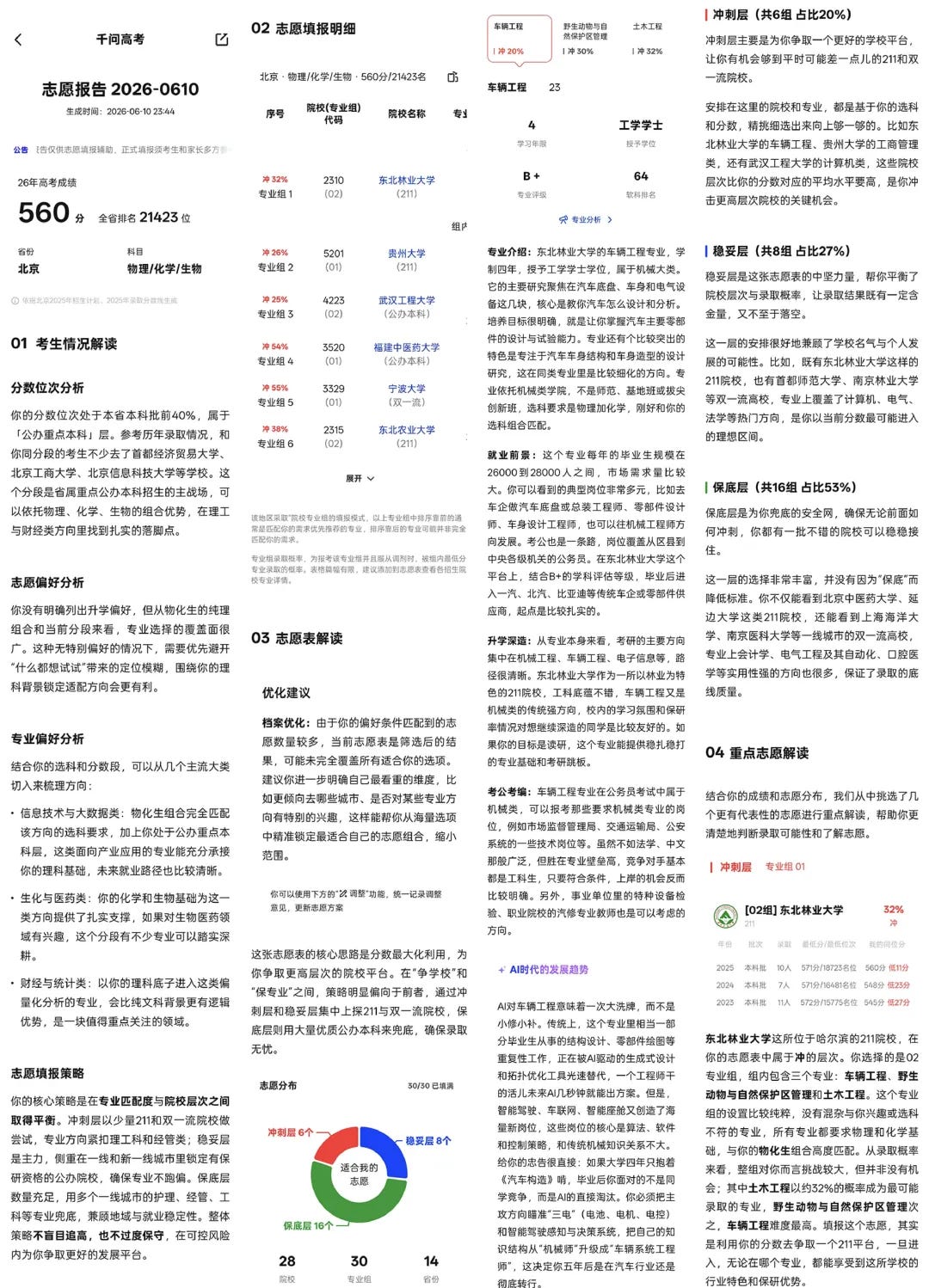
Here’s how the article pitches the service: “It transforms college application guidance from a business based on information asymmetry into an inclusive public service, ensuring that having a ‘dedicated advisor’ is no longer a privilege reserved for the few.” This reminds me of Zebra English, the AI English teacher service that appealed to parents who had trouble finding or paying the high costs for in-person English tutors.
The question, going forward, for AI services in this market: how do you convince users to trust your AI with real, vital interests like the college preference form?
As you’ll see in the full translation, I thought the last two sections were a bit too press-release-y, but the author seems to think Qianwen has developed this reputation of “getting things done” to earn the trust of the general public.
But overdependence on Qianwen could raise issues. As one of the top WeChat comments on the article (26 likes) points out: “Aren’t you concerned that AI responses might become homogenized? If it recommends the same schools, or suggests the same preferences, to all students within the same academic tier, what would the ultimate outcome be?”
FULL TRANSLATION: An AI that serves as a reliable “college preference form partner” is the one truly “worthy of trust”
ChinAI Links (Four to Forward)
Should-read: Just Above the Exam Cutoff Score: Elite College Admission and Wages in China
Ruixue Jia, a professor at UCSD, co-authored this NBER working paper on the impact of scoring just above the cutoff to get admitted to an elite Chinese college on future wages. This paper provided a lot of the background information used above.
Should-read: Exporting U.S. Military AI Won’t Be Easy
In Foreign Policy, GovAI research scholar Jake Steckler studies how middle powers are making decisions about acquiring and developing military AI. One interesting detail: “France has pitched Mistral, in Europe and beyond, as a path to military AI that reduces dependence on the United States and China.”
Should-read: TP-Link’s American Dream
The Wire China is really starting to distinguish itself for in-depth reporting on China’s economy. By Noah Berman, this cover story on the router firm TP-Link weaves together so many threads, including geopolitics, globalization, American makeovers, and industrial policy.
Should-read: Life by Lu Yao, translated by Chloe Estep
This week’s feature article mentions the Chinese novel Life, which I had not heard of. Has anyone read it?
Thank you for reading and engaging.
These are Jeff Ding’s (sometimes) weekly translations of Chinese-language musings on AI and related topics. Jeff is an Assistant Professor of Political Science at George Washington University.
Check out the archive of all past issues here & please subscribe here to support ChinAI under a Guardian/Wikipedia-style tipping model (everyone gets the same content but those who can pay for a subscription will support access for all).
Any suggestions or feedback? Let me know at chinainewsletter@gmail.com or on Twitter at @jjding99