 ChinAI Newsletter
Greetings from a world where…
North American league of legends is closing the gap!
…As always, the searchable archive of all past issues is here. Please please subscribe here to support ChinAI under a Guardian/Wikipedia-style tipping model (everyone gets the same content but those who can pay support access for all AND compensation for awesome ChinAI contributors).
Feature Translation: Most Companion Robots Die by Day 30
Context: Usually, I have a good sense of which translations will win the Around the Horn issues, but readers surprised me this time around. People were very interested in the Huxiu piece about companion robots, based on insights gathered from a roundtable of startup founders and investors in this domain.
In recent weeks, the Chinese AI hardware community has been buzzing over UBTech’s humanoid robot (“The gold standard of the adult/intimacy sector,” “A price point that is also the standard,” “88 degrees of freedom,” and “Incredibly realistic facial details”). Using this as a jumping off point, this roundtable conversation discussed how intelligent companion robots can shift from a one-off novelty to commercializable products that can prove their worth across various application scenarios.
Key Takeaways: In many ways, it’s harder to adapt AI for companion robots than it is for industrial humanoid robots. As this Fast Company article points out, “Right now, Chinese companies like Unitree or Xpeng and American corporations like Tesla or Figure AI are ignoring humanoids of this kind, focusing on more utilitarian designs….This is because putting one of these robots in a house is far more complicated than deploying one in an industrial setting, where environments are controlled and tasks are repetitive.”
The industry experts relayed their biggest fear: the “unboxing high, then unused three days later” scenario. For some companion robots, the return rate reaches 30%.
From the article: “Model capabilities will become increasingly cheap, while scenario-specific evaluation datasets will become increasingly expensive. Most companion products will not die because their AI models lack power, but because users stop opening the app by Day 30.”
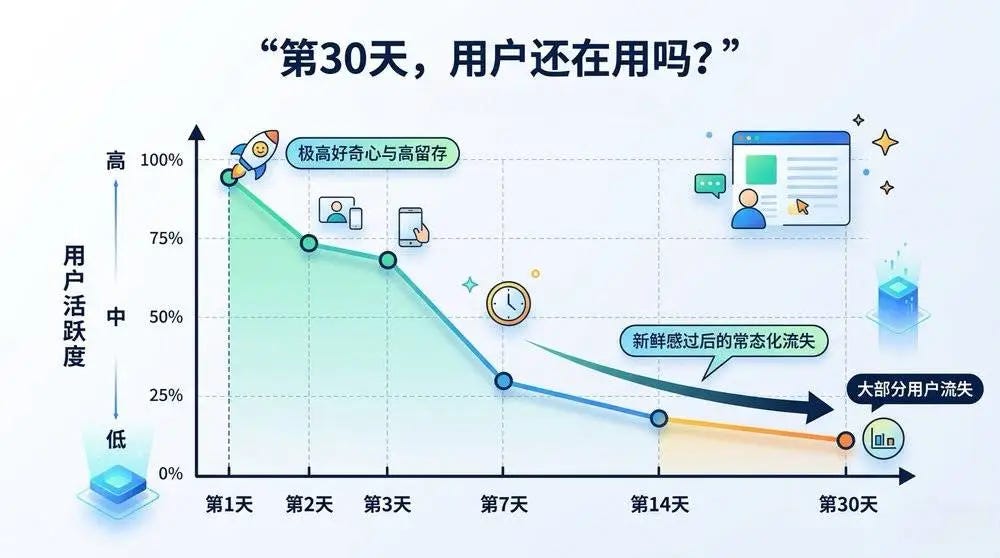
Players in China’s companion robot sector are realizing that AI capabilities are not the determining factor of adoption and retention. In the past, investors focused on: “does it have large models,” “is the Demo cool”, or “does it look cute?” Now, non-technological factors matter more, including what are actually paying for when they seek out companion robots, liability concerns, and integration as a reliable household presence.
Li Yulin, Founder of Koumeng Technology [叩梦科技], estimates that the cost of smart robot “cores” (the control units that integrate voice modules and AI algorithms) has dropped to just a few dozen RMB in Shenzhen’s. The article notes, “‘Low-end’ products—essentially ‘toy-grade casings paired with large models’—will quickly be replicated across the supply chain, triggering a race to the bottom on price.”
This means other factors will serve as differentiators. For instance, product fit matters. When it comes to companion robot toys to help children learn, the Qidian Lingzhi [奇点灵智] start-up firm struggled at first. Children just refused to keep playing with the toy, as they felt like they were pressured to keep speaking in essays. So, the start-up developed a model that teaches English education through a game setting: “When the child is cooking a steak in a Magic Restaurant game, they must say the word ‘steak’ to keep cooking. The kid experiences a game, while the mother hears the child speaking English.”
Companion robots also raise unique ethical and liability concerns. One conundrum: to achieve emotional connection, companion robots have to become more human-like; however, this raises the risk of emotional and psychological dependency. These liability issues have intensified with China’s new regulations on human-like interactive AI services (see ChinAI #341 coverage).
Hu Chen, co-founder of Qidian Lingzhi, positions the start-up’s competitive moat as not simply applying a LLM to a different setting but instead developing a very clear sense of “what constitutes good versus bad interaction within specific scenarios.” Then, the firms that win out will be the ones that develop high-quality, clear evaluation datasets that integrate insights from real-use testing, dense scenarios, and long-term tracking.
FULL TRANSLATION: Most Companion Robots Die by Day 30
ChinAI Links (Four to Forward)
Must-read: Labelling AI-Generated Content in China - Where the Rules Work and Where They Don’t
People write a bunch of stuff about the initial release of Chinese regulations. People write a lot fewer pieces about the actual implementation of these regulations, and that’s where Zilan Qian’s artice for Oxford China Policy Lab makes a huge contribution. She traces the enforcement gaps in China’s 2025 Measures for Labelling AI-Generated Synthetic Content.
Should-read: Are There Any Good Ideas for AI Governance?
This was an informative ChinaFile Conversation that explored fruitful ideas for AI governance and regulation in both China and the U.S., with a focus on topics that could be common ground.
Should-read: Fan Yang, Back to the Future: A Walk through Huaqiangbei in 2025
Fan Yang, University of Maryland, Baltimore County professor, reflects on her experiences with Huaqiangbei, a Shenzhen district mentioned in this week’s translation:
As someone who grew up in Shenzhen in the 1980s-1990s and has lived in the US since 2000, I’ve come to see returning to the Special Economic Zone today as a journey “back to the future.” During my last trip there, I walked down the “memory lane” of Huaqiangbei (Huaqiang North Road, or HQB), the place once known for Shanzhai (or “knockoff”) cell phones back in the early 2000s but that was re-branded around 2015 as China’s “No. 1 Electronics Street.” To many, HQB emblematizes the city’s 40-year history borne of China’s post-1978 Reform and Opening Up. As I found my way there just after the Chinese New Year in 2025, the comingled notion of time – simultaneously captured in the “back to” and “the future” – was precisely what I experienced.
Should-read: Who is us: the globalization of innovation and challenges to assessing technological dependence
Re-upping my latest article from my day job of being a political scientist. Anytime someone talks about China’s indigenous innovation push or technological self-sufficiency quest, ask them one simple follow-up question: how is that measured in the first place? The answer to that “Who is Us” question might lead you to more thorny questions about corporate nationality and globalization’s enduring stickiness.
Thank you for reading and engaging.
These are Jeff Ding’s (sometimes) weekly translations of Chinese-language musings on AI and related topics. Jeff is an Assistant Professor of Political Science at George Washington University.
Check out the archive of all past issues here & please subscribe here to support ChinAI under a Guardian/Wikipedia-style tipping model (everyone gets the same content but those who can pay for a subscription will support access for all).
Any suggestions or feedback? Let me know at chinainewsletter@gmail.com or on Twitter at @jjding99